
As we enter April 2026, the global technology sector shows no signs of slowing workforce reductions. A total of 78,557 tech employees have been laid off worldwide since January, a figure that already puts the industry on course to rival some of the heaviest years of the post-pandemic correction, and the year is far from over. January opened with more than 27,000 redundancies as major companies moved quickly on restructuring plans, before a brief easing in the months that followed. March proved the most turbulent month of the year so far, accounting for over 33,000 job cuts on its own, the highest single-month total of 2026 to date.
The wave of redundancies follows several years of post-pandemic correction, during which more than a million tech jobs were eliminated globally. What began as a pullback from pandemic-era overexpansion has evolved into a structural shift in how technology companies operate. Automation, artificial intelligence integration, and sustained cost-discipline measures continue to drive much of the downsizing, with entire departments restructured or eliminated in favour of leaner, AI-assisted workflows.
To better understand it, the team at RationalFX investigated the wave of layoffs in the technology sector, analysing the number of job cuts that have occurred throughout 2026. Based on figures from several sources, including TrueUp, TechCrunch, and multiple state WARN databases, we identified the companies with the most significant workforce reductions since the start of the year.
The Countries Most Affected By Tech Layoffs
Since the start of the year, tech companies have announced 78,557 job cuts worldwide, with 59,510, roughly 76.7% of the global total, occurring in the United States-based companies. These reductions span 54 American companies, with the largest cuts coming from enterprise software maker Oracle, e‑commerce and technology giant Amazon, Mark Zuckerberg’s Meta, and fintech and payments provider Block.
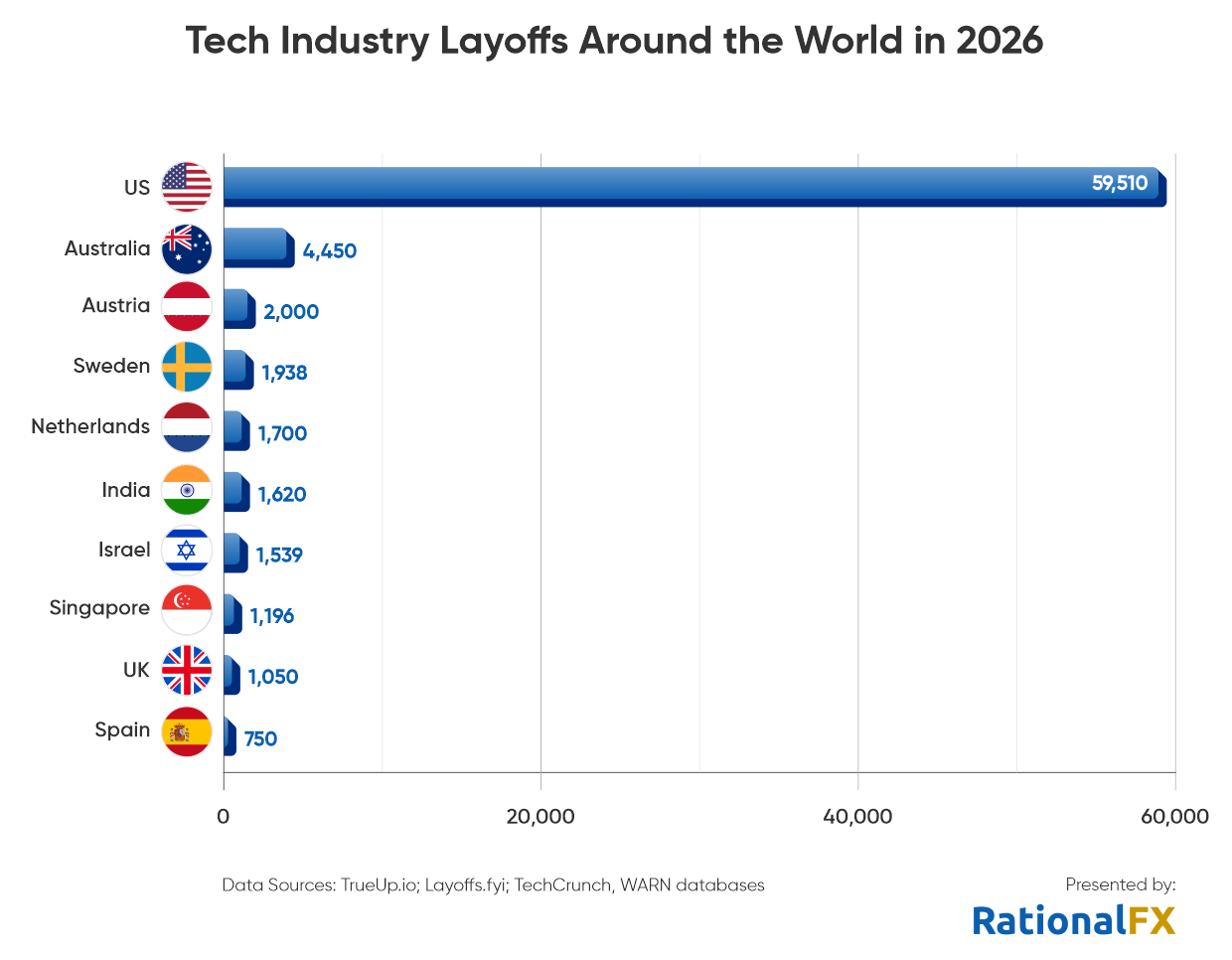
Australia has recorded around 4,450 job losses so far in 2026, with the most significant cuts concentrated among a handful of major companies. Sydney-based WiseTech Global accounts for the largest share, having reduced its workforce by 2,000 roles. This is followed by software firm Atlassian, which has cut 1,600 jobs, and Melbourne telecommunications company Telstra, where a further 650 positions have been affected since the start of the year. Although the overall scale of layoffs in Australia remains well below that seen in the United States, the fact that such a large proportion of job losses is concentrated within a small number of high-profile firms shows the true depth of the impact at a regional and industry level.
Europe accounts for a smaller but still notable share of global layoffs, with Austria (2,000), Sweden (1,938), the Netherlands (1,700), the UK (1,050), Spain (750), France (259), Germany (200), and the Czech Republic (250) among the most affected countries. As in previous months, the region’s layoffs remain concentrated in the semiconductor, telecom, and technology services sectors, reflecting ongoing structural shifts across traditional European tech hubs.
Asia has seen 4,580 layoffs across several countries, with the largest numbers coming from India (1,620), Israel (1,539), and Singapore (1,196). The cuts span AI startups, e‑commerce platforms, cybersecurity firms, and electric mobility companies. Notably, AI and automation-related layoffs make up a significant portion of the region’s cuts, particularly in Israel and Singapore, highlighting the structural transformation in tech workflows.
More Than Half The Global Workforce Reductions in 2026 Stem From Two Companies
Leading all technology companies in 2026’s workforce reductions by a considerable margin, enterprise software giant Oracle has laid off 25,254 employees across several rounds of cuts since the start of the year. Smaller reductions in late 2025 gave way to a much larger wave in March of this year, when thousands of employees across the United States, India, Canada, and Mexico received termination emails with no prior warning from HR or their managers. The latest cuts are directly tied to Oracle’s aggressive push into AI infrastructure, and the contradiction is hard to ignore. In its fiscal Q2 2026 results, the company reported a 95% jump in net income to $6.13 billion, yet it is simultaneously eliminating tens of thousands of roles to free up the cash flow needed to fund its data centre buildout.
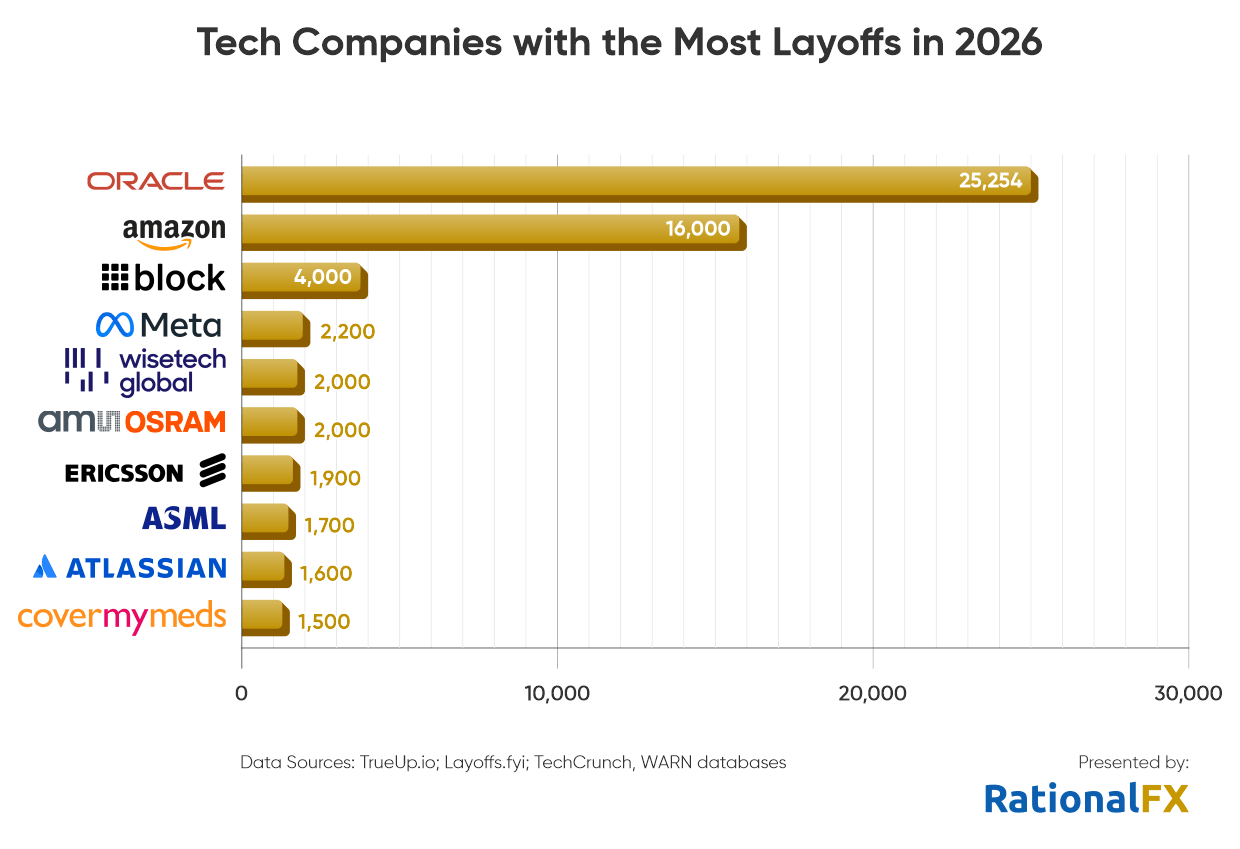
After cutting nearly 20,000 roles in 2025, the second-largest total among tech companies that year, the e-commerce and cloud computing giant Amazon has announced a further 16,000 job reductions in 2026, one of the largest single workforce cuts in its history, following 14,000 redundancies in October 2025. Company management cited efforts to streamline reporting, accelerate decisions, and boost efficiency. Yet these cuts come amid record revenues of $716.9 billion in 2025 (up 12% year-on-year, with explosive AWS growth) and massive ongoing investments in artificial intelligence and cloud infrastructure, including a projected $200 billion in capital expenditures for 2026 alone.
Social media and technology giant Meta has cut approximately 2,200 jobs in 2026, expanding beyond its initial round of reductions earlier in the year. The cuts have affected its Reality Labs division, the unit tasked with building virtual reality headsets, Horizon Worlds, and other metaverse-related projects as the company continues to pivot away from costly metaverse investments toward higher-priority areas like artificial intelligence. Meta executives, including CTO Andrew Bosworth, have framed the layoffs as part of a broader effort to streamline operations and reallocate capital to products with stronger market traction, even as the company maintains its long-term augmented-reality ambitions.
Semiconductor and sensor manufacturer ams OSRAM also intends to cut around 2,000 jobs as part of a broader restructuring programme aimed at improving profitability and streamlining operations. The Austria-based group has been under pressure to reduce costs following weaker demand in some segments of the semiconductor market, prompting a series of efficiency measures across its global operations.
Sweden-based telecommunications equipment maker Ericsson has moved forward with a significant workforce reduction in early 2026, announcing plans to cut approximately 1,900 jobs, the bulk of which stem from a proposed reduction of around 1,600 positions in its home market as part of broader cost-efficiency measures. The company, which said it had begun formal consultations with Swedish trade unions and notified the Swedish Public Employment Service, framed the cuts as necessary to strengthen its competitive position amid a sluggish global 5G market and intensifying industry competition.
Dutch semiconductor equipment maker ASML confirmed it will eliminate around 1,700 jobs in early 2026, even as it rode a wave of strong demand for advanced chipmaking systems and reported record sales and profits in 2025. The reductions, roughly 4% of its global workforce, are focused primarily on management, technology, and IT roles in the Netherlands and, to a lesser extent, the United States, and are part of a broader effort to simplify the company’s organisational structure and sharpen its engineering focus.
Columbus, Ohio-based Healthcare technology company CoverMyMeds has confirmed 1,500 layoffs as part of a broader restructuring by its parent company. The Columbus, Ohio-based firm, which provides electronic prior authorisation and medication access solutions, has seen its operations significantly scaled back amid shifting priorities within its parent organisation, resulting in one of the more notable healthcare-adjacent tech layoffs of 2026.
Nearly Half The Total Layoffs in 2026 Are AI-Related
Artificial intelligence and automation are increasingly cited as key factors behind workforce reductions across the technology sector. In total, 38,279 layoffs in 2026 so far have been linked directly to AI adoption, automation, or organisational restructuring tied to these technologies, a figure that keeps growing larger as the year progresses.
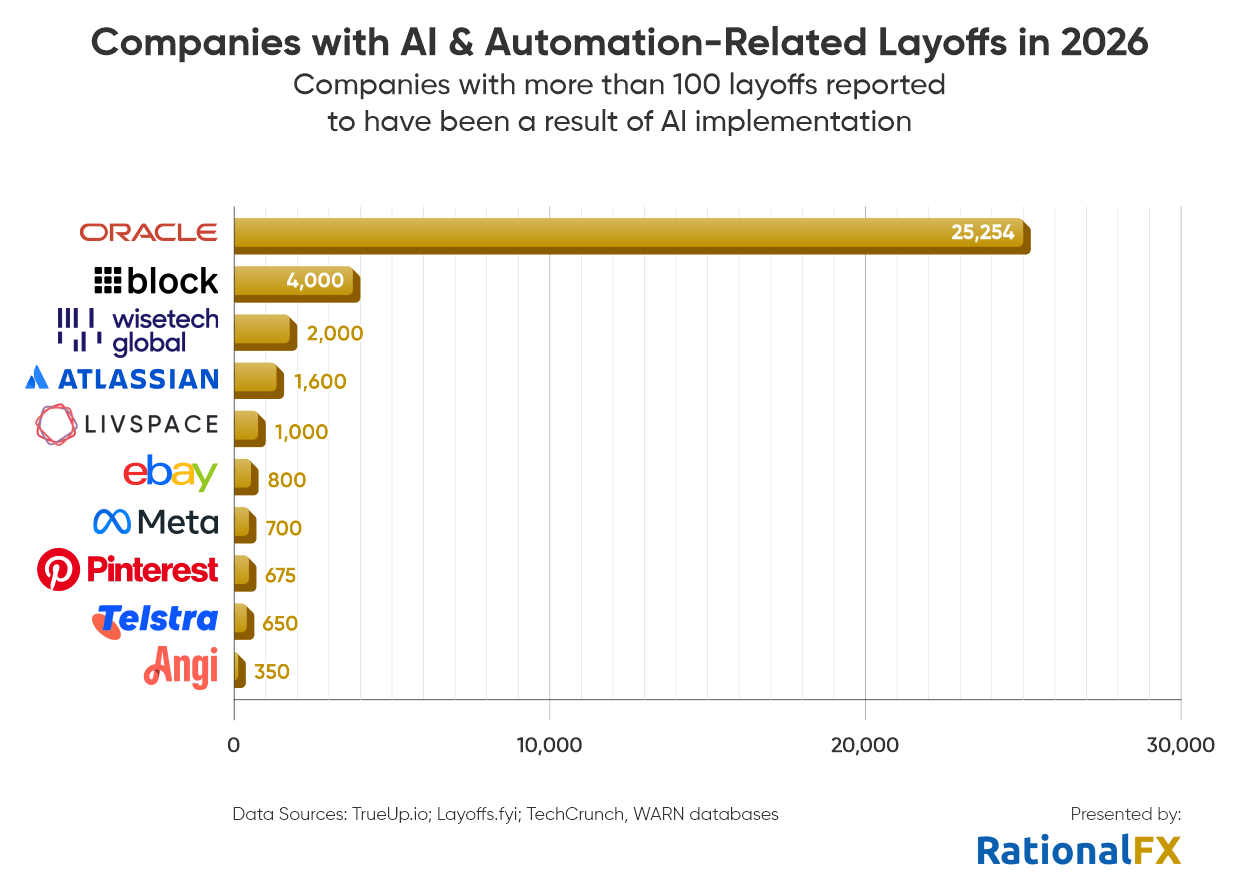
Oracle tops the list of AI-linked redundancies by a wide margin, accounting for roughly 25,254 layoffs affecting employees in the United States, India, Canada, and Mexico. It is estimated that the total cuts will affect between 20,000 and 30,000 employees, roughly 18% of Oracle’s global workforce, freeing up $8-10 billion in cash flow to fund a $156 billion AI infrastructure buildout that the company has been financing heavily through debt.
U.S. fintech company Block follows with 4,000 roles eliminated, with CEO Jack Dorsey stating explicitly that AI could now automate much of the work those employees had been doing, a framing that several analysts have described as a marker for what other companies would soon replicate. That prediction proved accurate.
In March, Australian software maker Atlassian announced 1,600 layoffs, roughly 10% of its global workforce, with CEO Mike Cannon-Brookes describing the cuts as a necessary pivot toward becoming an AI-first company. The company said the restructuring would free capital to self-fund further investment in AI and enterprise sales. More than half of the affected roles came from software research and development, a detail that drew scrutiny, given that Atlassian had publicly stated just months earlier that it would be hiring more engineers, not fewer.
Logistics software developer WiseTech Global accounts for 2,000 of the AI-linked layoffs, having announced a major restructuring aimed at increasing automation across its logistics platforms. Singapore-based home design platform Livspace has cut 1,000 positions as it shifts toward more automated design and operations systems. E-commerce platform eBay eliminated 800 roles, with leadership citing greater efficiency through automation and AI-driven product development, while social media platform Pinterest announced 675 layoffs, emphasising the need to invest more heavily in AI-powered advertising and content discovery tools.
Together, these layoffs reflect a growing and increasingly difficult-to-ignore shift within the technology sector, where companies are restructuring workforces to prioritise AI development while eliminating roles now considered automatable, and where the line between genuine transformation and cost-cutting under an AI banner is becoming harder to draw.
Austin, Texas, Surpasses Seattle as the Epicentre of Global Workforce Reductions in 2026
In the United States, Austin, Texas, has emerged as the unexpected epicentre of global tech layoffs, with 25,284 employees affected, a figure driven almost entirely by Oracle, which relocated its headquarters to the Texas capital in 2020 and has since made it the base for its most sweeping workforce reductions in the company’s history.
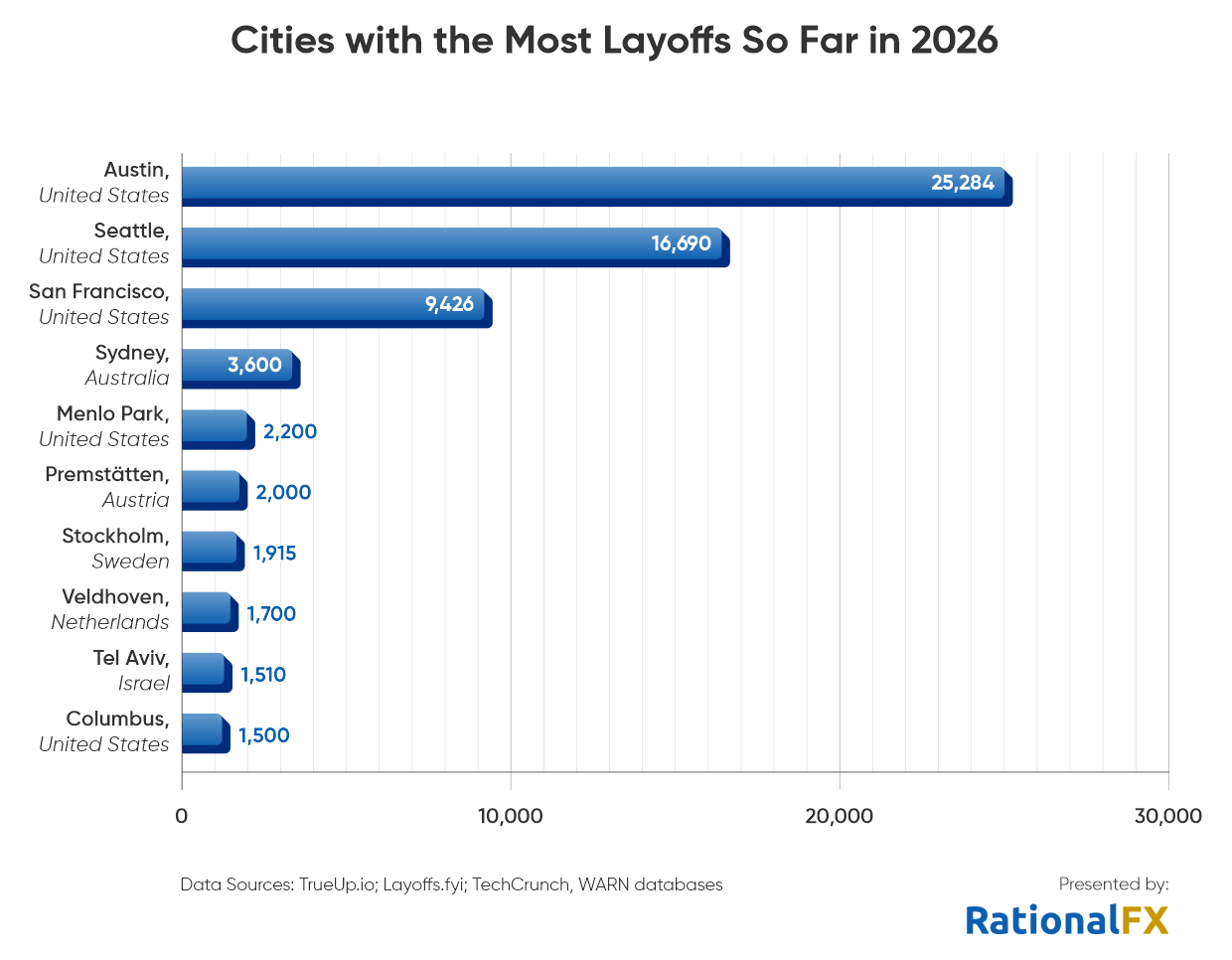
Seattle, home to Amazon and Microsoft, follows with 16,690 employees affected worldwide, while San Francisco accounts for 9,426 layoffs, reflecting the continued restructuring of major tech firms headquartered across the Bay Area.
Outside the United States, Sydney ranks among the most impacted cities globally, with 3,600 redundancies stemming primarily from logistics software developer WiseTech Global and telecommunications giant Telstra, whose combined cuts make Australia’s largest city one of the more significant non-US hubs on the map this year.
In Europe, three cities feature prominently. Premstätten in Austria has seen 2,000 job cuts at semiconductor company ams OSRAM, with the impact likely concentrated across its core Austrian and German sites as the company consolidates operations and scales back legacy lighting activities. Stockholm accounts for 1,915 layoffs tied to Ericsson’s ongoing cost-efficiency programme, while the Dutch town of Veldhoven, home to ASML, records 1,700 reductions, even as the semiconductor equipment maker continues to report record demand for its products.
In Asia, Tel Aviv reports 1,510 layoffs, reflecting the wave of AI startup restructuring and cybersecurity sector adjustments that have made Israel one of the hardest hit tech hubs outside of North America.
The State of the Tech Industry in Early 2026
The tech sector continues to navigate the aftermath of the COVID-19 pandemic, which impacted more than a million tech employees around the world since 2021. The first month of 2026 has already seen a surge in layoffs, and based on current trends, if job cuts continue at the same intensity, total reductions could reach 318,592 by year-end, surpassing 2025’s 245,000 layoffs.
The narrative around AI has shifted from long-term strategy to immediate financial impact. By early April 2026, AI-driven restructuring accounted for nearly half of all recorded layoffs, marking a sharp escalation from late 2025. What is particularly striking is the scope of these cuts: they are no longer confined to operational or support roles, but increasingly extend to senior leadership, engineering teams, and even entire product divisions, as companies reorganise around the expectation that AI can absorb a growing share of the workload.
However, the reality is more complex than the headline figures suggest. Despite strong corporate messaging around efficiency gains, only a relatively small share of organisations have AI systems ready for deployment, and fewer still are using them at scale. In practice, many firms appear to be restructuring ahead of the technology’s actual capabilities. This raises the likelihood that a portion of these AI-linked layoffs will be followed by quieter rehiring, often in lower-cost regions, as companies adjust to the gap between expectation and execution.
At the same time, hiring trends indicate a shift rather than a broad contraction. Demand for AI and machine learning specialists continues to rise, even as overall tech hiring declines, pointing to an industry that is consolidating around a narrower and more specialised set of skills. Whether this transformation ultimately creates as many roles as it eliminates remains an open question, one that 2026 is unlikely to resolve definitively.
Methodology
For this report, the team at RationalFX examined all of the reported tech company layoffs since the beginning of 2026, sourced from the IT job portal TrueUp.io. We also searched through additional sources, including TechCrunch, Layoffs.fyi, and several WARN databases. These are publicly available announcements providing advance notice in cases of qualified plant closings and mass layoffs as required by the U.S. Worker Adjustment and Retraining Notification (WARN) Act.
Layoff figures were first aggregated at the company level to determine the total job cuts per firm. Next, companies were classified by their country of headquarters, providing insight into the geographic distribution of layoffs. To highlight the most significant workforce reductions, firms were ranked by the number of jobs eliminated, while countries were ranked based on the total layoffs reported by companies operating within them.